
How to Hang a Shower Curtain Rod With Sloped Attic Ceiling
THE HILL HOUSE
Of all the decisions in the Hill House hall bathroom, the one that got the most opinions was the shower curtain rod. Funny how the little things can become the big things ;) A while back I posted a photo of the tub on Instagram stories with a simple question: should the rod run straight across at the low point or follow the angle of the sloped ceiling? You guys had thoughts! So here’s what we learned, what we did, the other options we considered, and everything we’d tell you if you have a tub tucked under a sloping roofline like us. Let’s get into it…
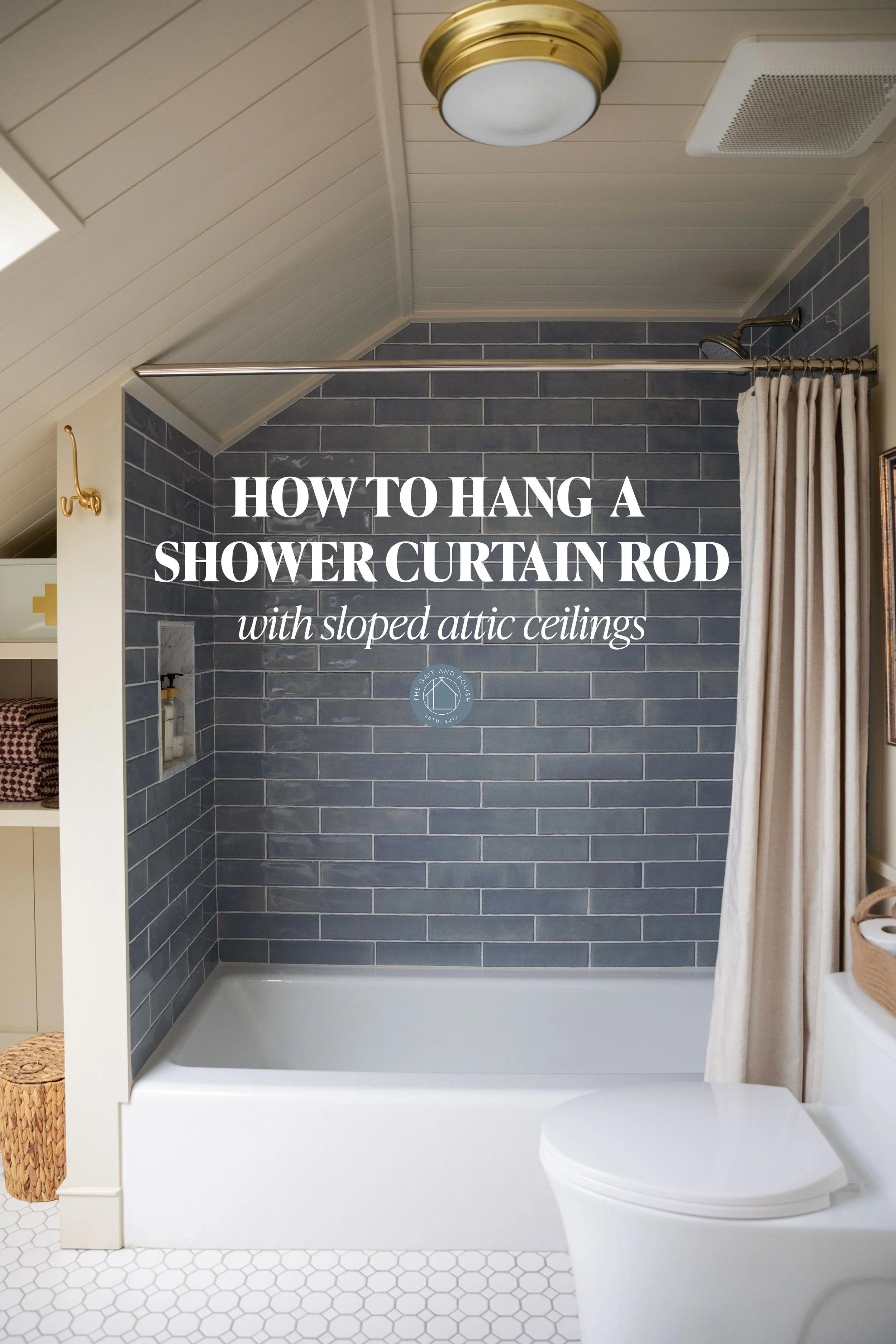
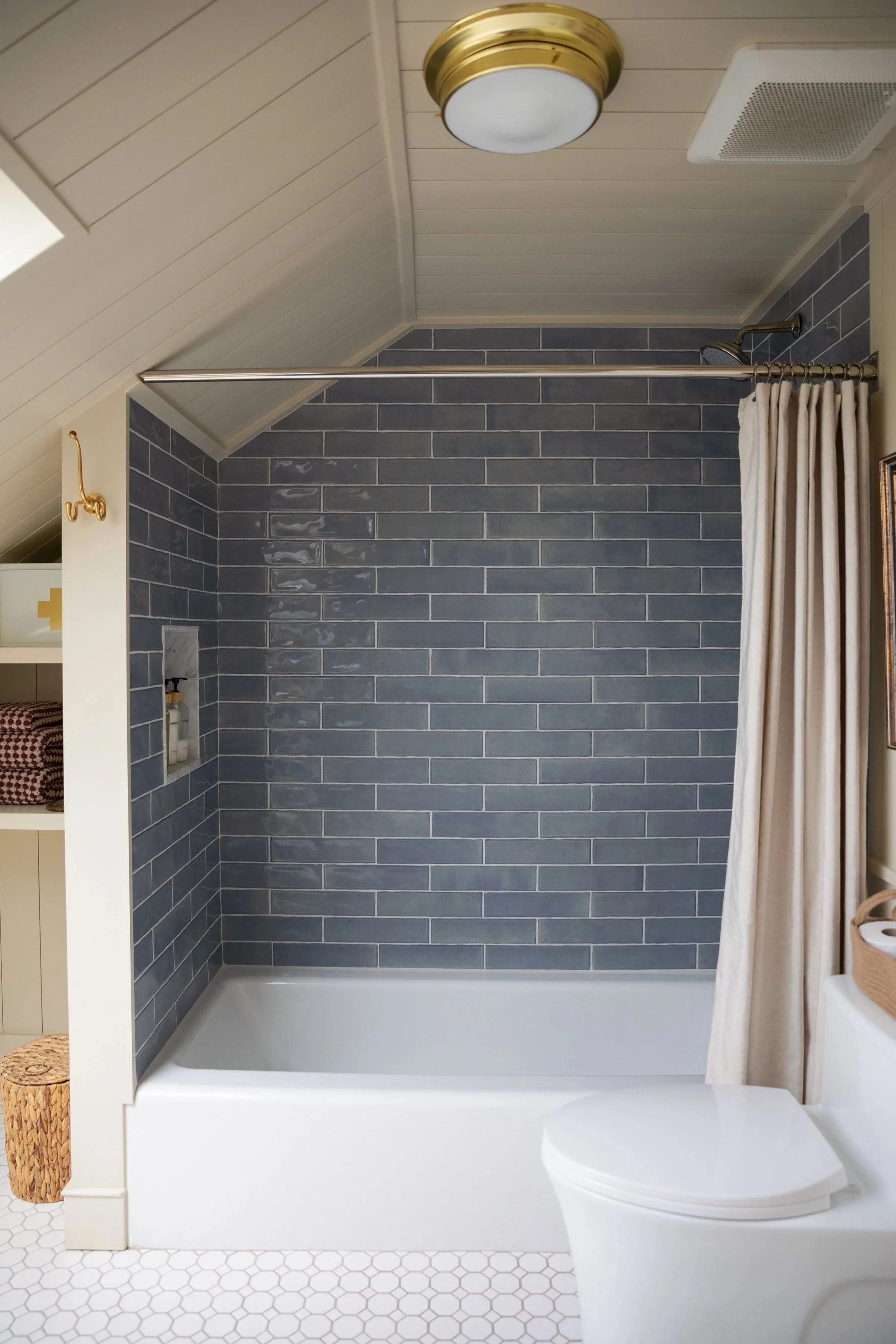
rod, curtain, wall tile, floor tile, tub, toilet, paneling, light, color: F&B off white
psst: stay tuned for the reveal of this bathroom next week!
The short answer: if your tub is tucked under a sloped ceiling, you’ve got a few realistic options: a straight rod at the low point of the slope (what we did), a straight rod on angled swivel mounts so you can hang it higher, a bent rod that follows the slope, a rod hung from the ceiling, or skipping the curtain for glass. We picked the simplest one and it was definitely the right call here.
The Problem: A Ceiling That changes height
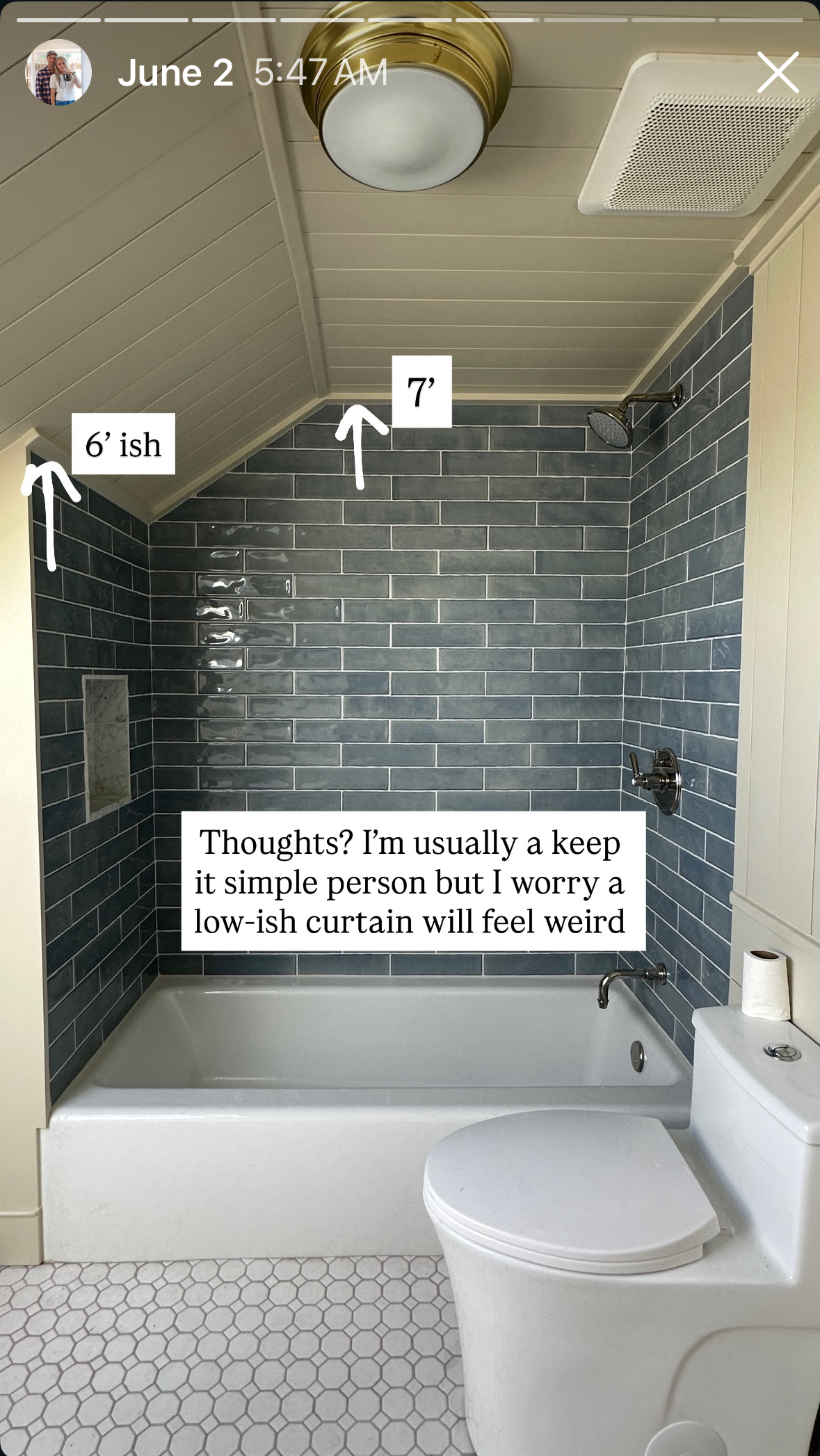
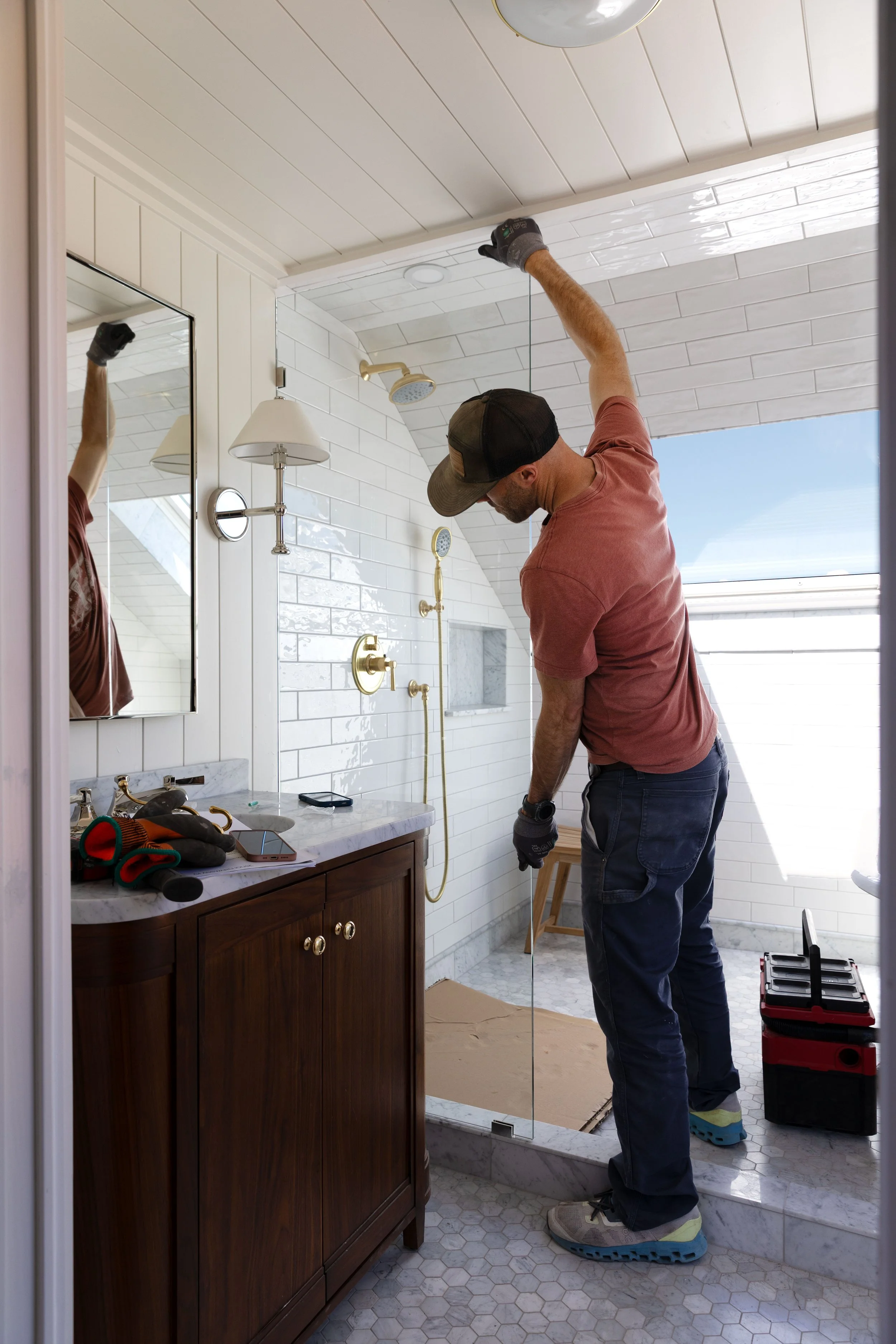
This bathroom lives upstairs, halfway under the eaves, and the ceiling over the tub slopes down toward one end. It’s roughly six feet at the low end and seven at the high end. Most curtain rod hardware assumes a flat ceiling and two parallel walls. We had neither. So we went back and forth for a while (like months and months), weighing what would look best and what would actually work every single day. Here’s everything we considered, and some mocks ups that helped us decide.
I’m sharing exactly what I posted on IG stories so excuse the lower-quality iPhone photos…
First, a Quick Reality Check: How High Should a Shower Curtain Rod Be?
Before we get into the options, a little context, because it totally changed how I felt about our low end. Most guides put a shower curtain rod somewhere between 72 and 78 inches off the floor, and 75 to 77 inches is the usual sweet spot for a standard 72-inch curtain (extra-long curtains come in 84 and 96 inches). Our low end is roughly six feet, or 72 inches. So even our “low” option sat right at the bottom edge of normal, NOT some weirdly cramped outlier. That made our options a little easier, but did require me asking my mom to hem our standard shower curtain ;)
Options at a Glance
Here are the options we looked at for a shower curtain rod with a sloped ceiling. This is the quick version and then I’ll walk you through each one:
A straight rod at the low point (what we did). The simplest option, and it works with a standard curtain. The catch: the rod can only be as high as the lowest part of the slope.
A straight rod on angled swivel mounts. Lets you hang a straight rod higher. The catch: it needs solid backing in the sloped surface, and the mounts aren’t the prettiest.
A bent rod that follows the slope. Best if your low point is REALLY low. The catch: the curtain gets complicated (hems, puddling, sliding rings).
A rod hung from the ceiling. Works if there’s a flat stretch of ceiling right where the rod needs to go. The catch: it needs solid backing up there too.
Skip the curtain for glass. Makes the whole problem disappear. The catch: dealing with glass, and probably more cost and install work.
Option 1: A Straight Rod at the Low Point (What We Did)
A level rod at a single height, set at the lowest point of the slope. It’s the simplest choice, and the trade-off is that you either set the height to clear the slope at its lowest point or hang it higher and figure out what kind of bracket to use on the sloped side, since most rod brackets assume a 90-degree mount.
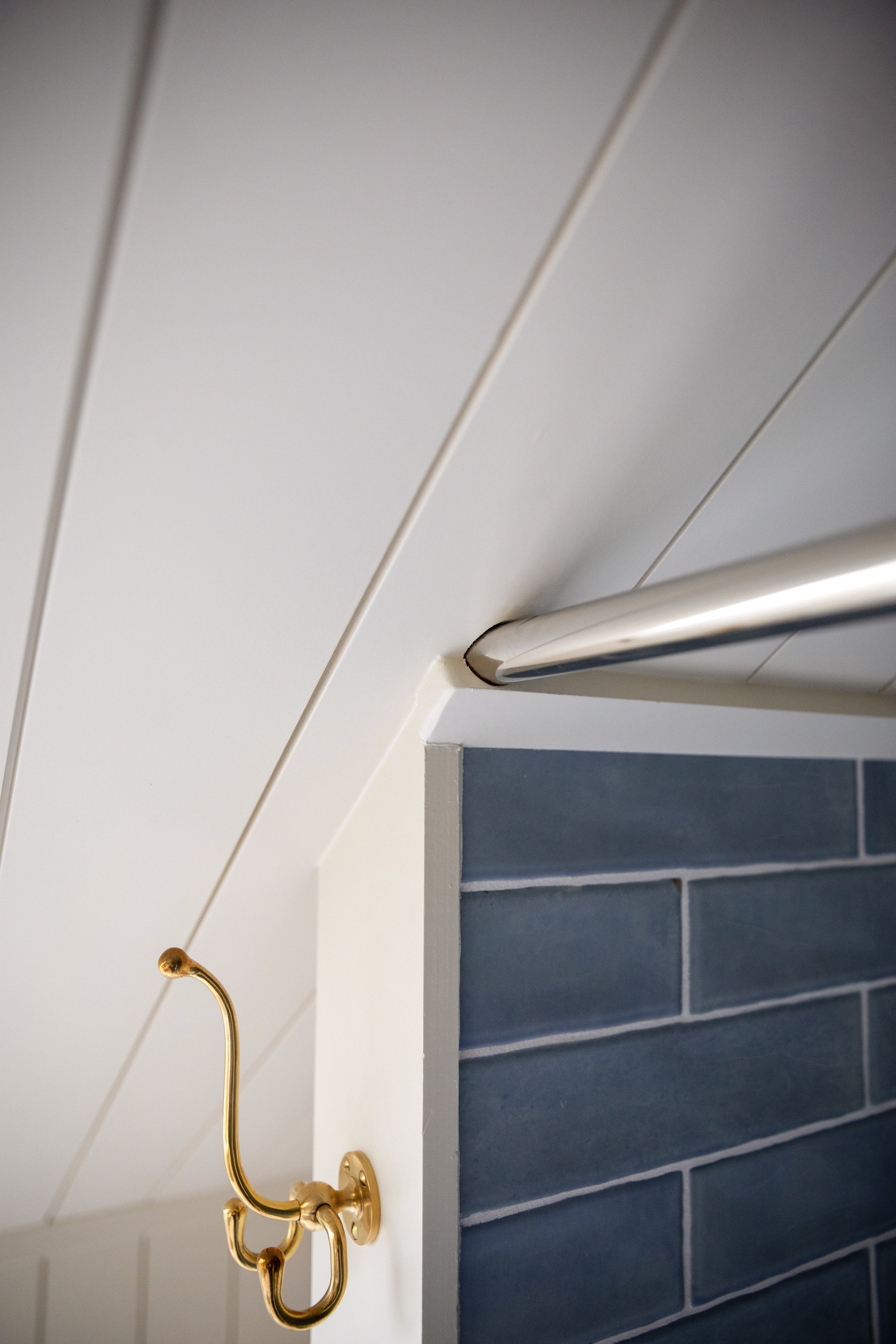
We’re not super tall people and we don’t mind a small duck to get into the shower but it would be nice if my 6'5" brother could use this shower when he visits. So I assumed we’d put the rod a little higher, partway up the slope. But then there’s the whole mounting to an angle problem. Garrett voted for the more practical option: set the rod at the bottom of the slope, drill a hole into the molding and seat the rod end right in it. Which left me with one big worry: would a lower rod feel cramped every time someone stepped behind the curtain?
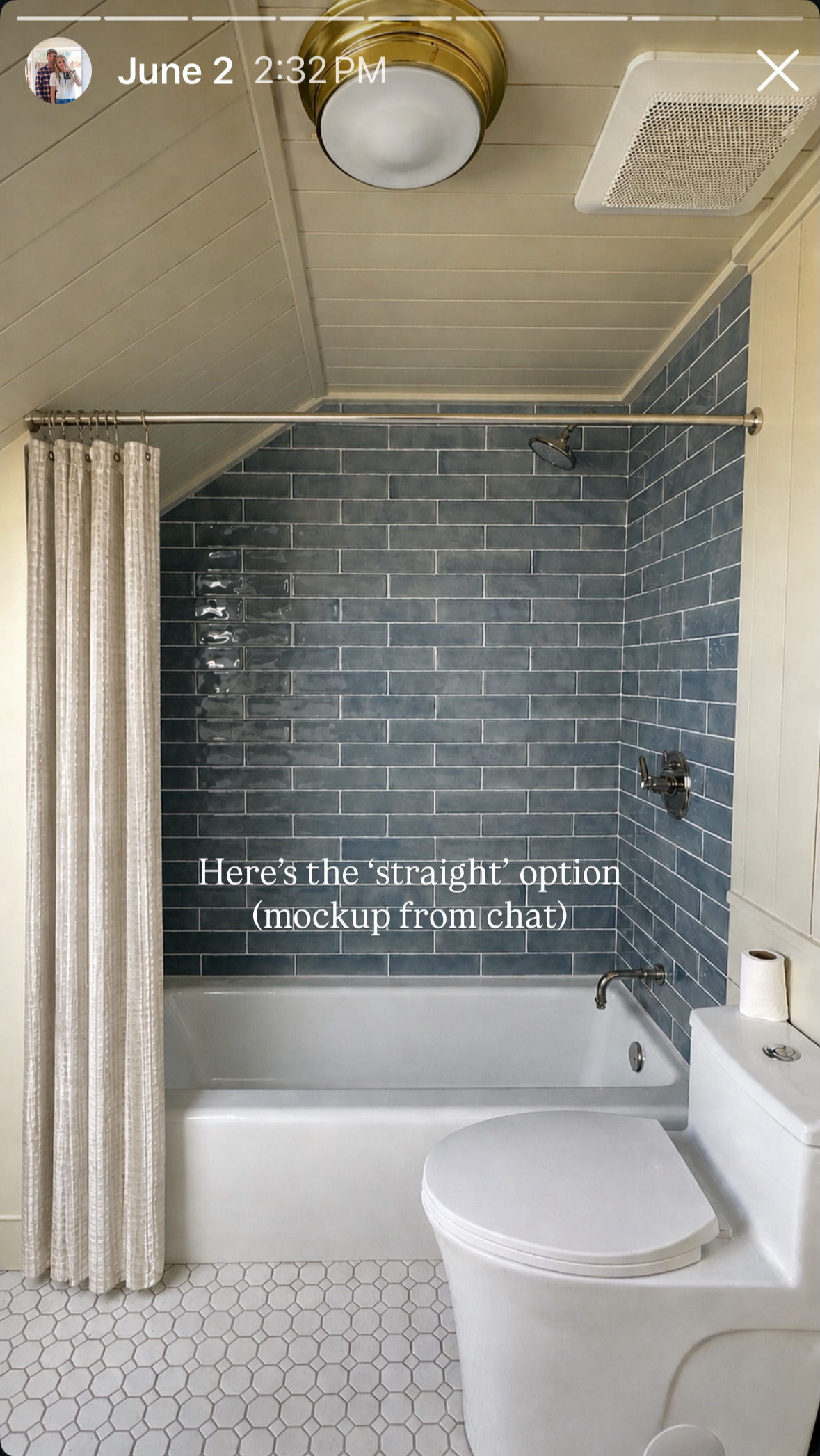
mockup
Option 2: A Straight Rod on Angled Swivel Mounts
If you’d rather hang a regular rod higher, you can buy swivel (ball-socket) mounts made to hold a rod at an angle against a sloped surface, and they’re pretty cheap (under $20 for a pair). This is the answer to my “what bracket do I use on the sloped side?” question from Option 1! Of course they might not be as pretty, but it’s an option. We haven’t used them, so take this as an idea rather than a recommendation. psst: double-check the rod diameter they accept.
Option 3: A Bent Rod That Follows the Slope
This one has the rod bending to match the roofline, maybe with a support dropping from the ceiling at the bend, so the rod sits lower on one end and higher on the other. It uses all of your available height and matches the room’s actual geometry instead of ignoring it. And I’ll admit, this is what I thought we’d end up doing.
I had planned to take our rod to a local metal fabricator and see if they could bend it perfectly for me. Plan B was to have Garrett cut it and place the seam in the ceiling mount to hide the fact it’s actually two rods installed at different angles. There are kits available that include a swivel support that hangs from the ceiling plus angled brackets at the ends (that answered my “but how would you even mount it?” question), and they started around $220. We haven’t tried one, so again this is a possible option, not a tested one. But as Garrett mentioned, this was a complicated option that wasn’t necessarily any better.
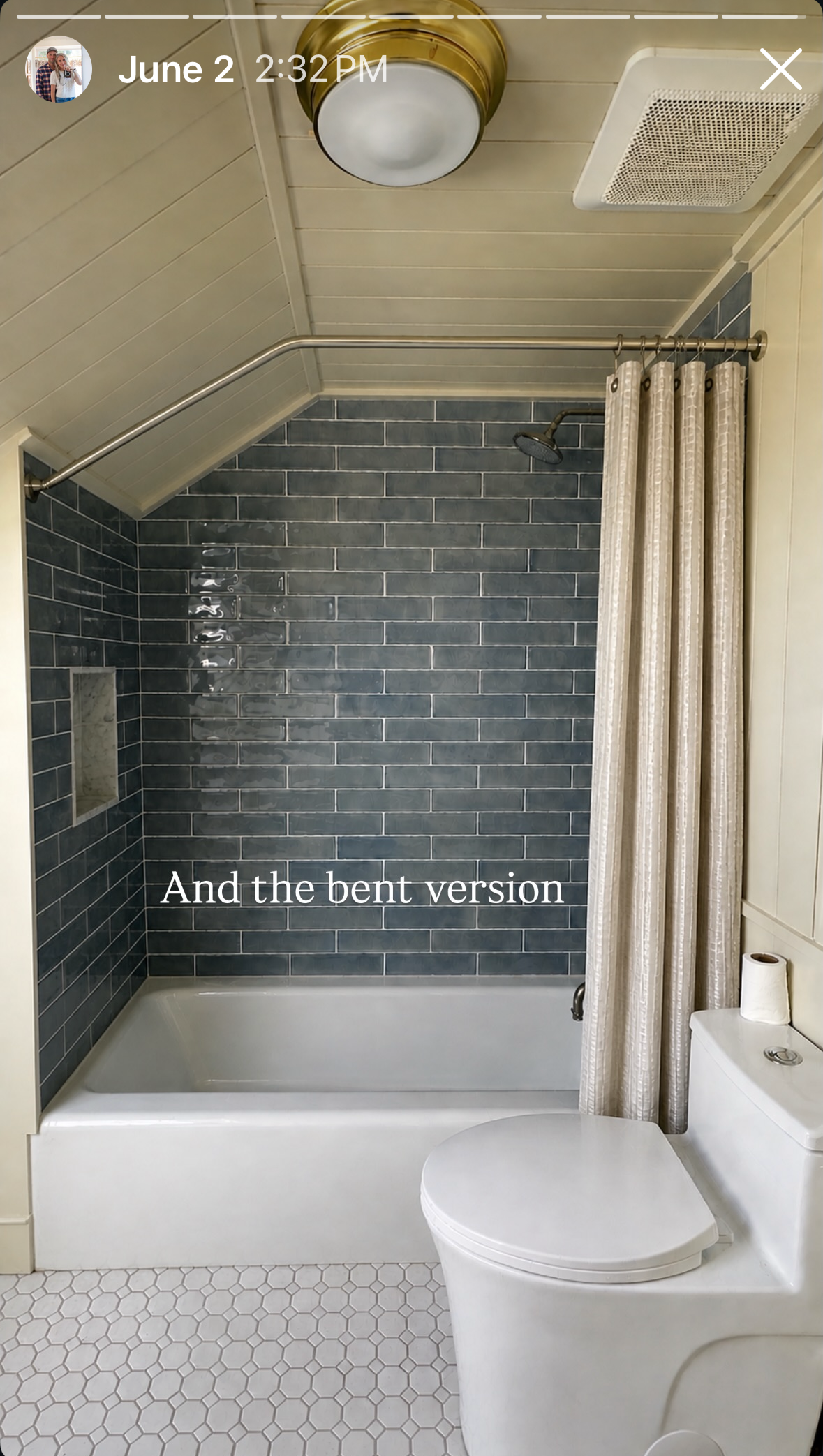
mockup
The biggest problem with this option wasn’t the rod (though that was a problem). It was the curtain. Here’s what worried us:
Puddling (or a gap). A curtain hangs the same length from every ring, so the hem follows the rod. On our slope that’s roughly a foot of difference between the low and high ends. Size the curtain for the high end and the low end puddles on the tub or floor. Size it for the low end and you’ve got a gap at the high end where water can escape. Neither is great!
Not opening far enough. Gravity pulls rings downhill, so a curtain you push open along the slope wants to creep right back down.
The bend. Of course if we added that ceiling bracket, the curtain would have to be unclipped and clipped on either side of the bracket in order to pass it. Not ideal.
So what do people do about it? There are workarounds and I’m not sure these are good but they’re options… Hem or cut the curtain on an angle so the bottom follows the rod. Would this look funny when the curtain is open? Probably. But it’s an option. OR you could just leave the curtain be and let it puddle on the low side. OR you could add a small wall or fixed glass panel to the angled side and butt the curtain rod into that, taking out the angled section all together. Honestly? Every one of those adds a step and quite possibly looks funny but they’re options.
Option 4: A Rod Hung From the Ceiling
Straight rods that hang from ceiling supports exist, and they can work if you’ve got a flat stretch of ceiling right where the rod needs to sit, since you’re not fighting the slope with wall brackets. You’ll still need solid backing up there to hold the supports. I don’t know that it would have worked here but it’s on the list if your ceiling is partly sloped.
Option 5: Skip the Curtain Entirely
In our ensuite, a sloped ceiling and a tall window made a curtain awkward, so we went with a glass panel instead. We shared exactly why, what it cost, and how easy the DIY install turned out to be (spoiler: quite easy!). It’s not a rod solution, but it does make the whole problem disappear in certain situations.
The Trick To a sturdier, prettier curtain rod…
Okay, let’s back up for a second because I have OPINIONS about shower curtain rods. Most of them are flimsy adjustable tubes with a seam right in the middle, and they look chintzy even in the prettiest bathroom. We’ve put so much love, money, and quality into this room that I wanted a rod to match. Something beautiful, seamless, and sturdy enough to last for decades.
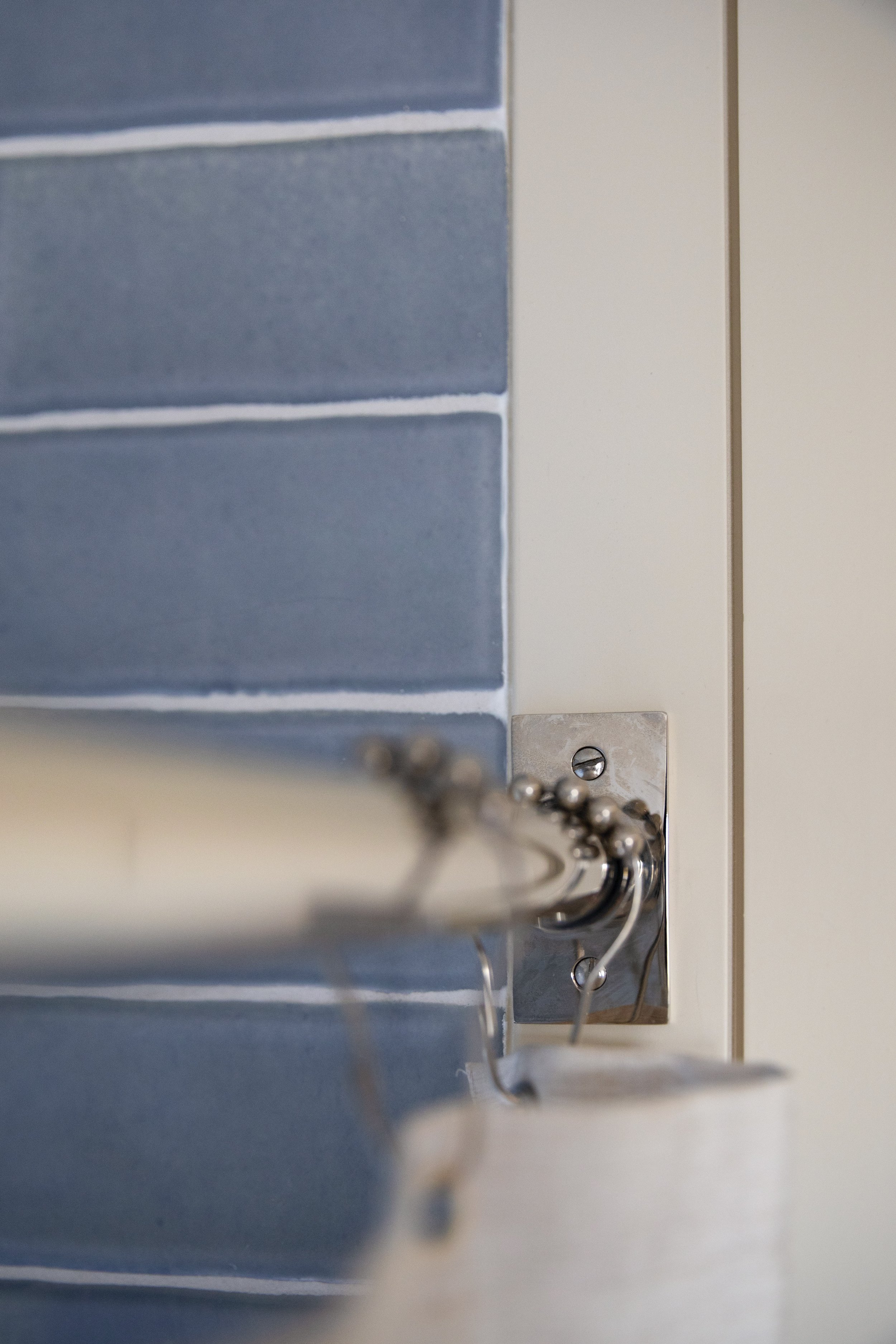
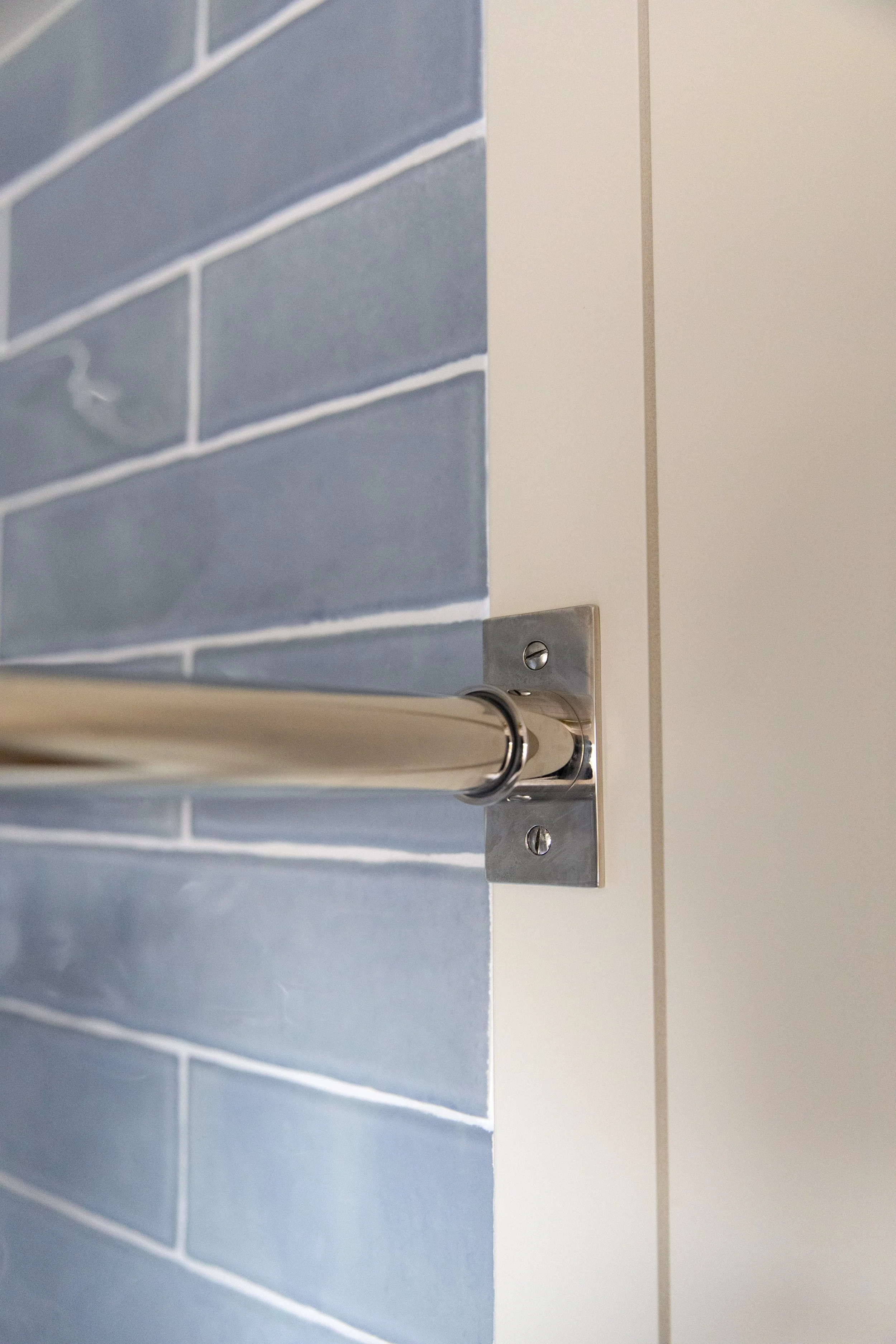
So we skipped the shower curtain rod all together and bought a laundry rod from Rejuvenation - the kind meant for a closet or laundry room, cut to our exact length and finished in polished nickel. Closet and laundry rods are built to actually hold weight, they come in finishes nice enough to be seen, and ordering one cut to length means you get one solid piece, with no telescoping seam and none of that wobbly adjustable feel. It’s a rod I’ll definitely use again. Highly recommend, especially if your kids are always stress-testing things like our’s are ;)
What We ended up Choosing (and How we like it)
We went with straight across, set at the low end of the slope. And that worry about a low curtain feeling cramped? It’s really not an issue. Part of it is that six feet turned out to be much less “low” than it sounded (note that Garrett’s the only person close to 6’ in our house and at 5’8” it doesn’t bother me at all). The left end sits in the molding and the other end mounts to the wall with the pretty bracket that came with our laundry rod. Simplicity won, and it was absolutely the right call for this room. Let this be a reminder (yet again) to Keep It Simple Stupid!
Of course if your slope is more dramatic than ours, or your low point is genuinely low, an adjustable bracket or angled rod (plus one of those curtain workarounds) is still worth a look. It just wasn’t what we needed here.
What We’d Tell You if You’re Working Around a Sloped Ceiling
Measure the actual low point, not the average. The number that matters for a straight rod is the ceiling height at its lowest spot along the rod’s path.
Pick your curtain length after your rod height. A standard curtain is 72 inches, and extra-long ones come in 84 and 96 (you can always hem one that’s too long like we did - thanks mom!).
Start with the simple option. If your low point is around 72 inches or higher, a straight rod at the low end is our pick. Save the angled stuff for when the slope really leaves you no choice.
Order the rod cut to length. You’re not stuck choosing between those extendable rods on Amazon. The rod we found is cut to your length (or you can do this at home like we did) so no seam is needed.
Plan your mounting before you buy. Whatever rod you choose, each end needs something solid to attach to. Our rod came with mounts, but we only ended up using one and let the other end terminate in the molding.
Don’t assume following the slope is the more custom-feeling choice. Sometimes the simple, level option is what makes an odd room feel calmer, not weirder.
Straight or angled… which would you have chosen? I’m definitely pleased with where we ended up, but goodness it sure took some thinking to get there!
Come back next week for the full reveal of this bathroom :)
xx
psst: this post contains affiliate links, meaning we may receive a small commission if you purchase something through them, at no additional cost to you. Thank you for supporting the Grit and Polish!

5 options + what we did